
-
VIII Course of Legal History – 2020/2021 | Law and Modernization: from the Early Modernity to the Technical Revolution (19th – 20th Century)

The Ius Commune – Interinstitutional Group on the History of Legal Culture, invites everyone to participate in the 2020/2021 edition of the traditional Course of Legal History. This year, we will work on the theme “Law and Modernization: from the Early Modernity to the Technical Revolution (19th – 20th Century)”.
PROGRAM
17/11/2021 (WED)
- 14:30 – Opening: Arno Dal Ri Jr., Caetano Dias Corrêa e Diego Nunes
- 14:45 – Conference: Mia Korpiola (University of Turku) – “Speeding towards the Future:
New Vehicles, Modernization and the Law” - 15:45 – Debate:Caetano Dias Corrêa
18/11/2021 (THU)
- 10:30 – Students research presentations: Diego Nunes
- 14:30 – Conference: Heikki Pihlajamäki (University of Helsinki) – “Modernization,
Nationalism, and Private Law Codification”.
- 15:00 – Debate: Arno Dal Ri Jr.
19/11/2021 (FRI)
- 10:30 – Conference: Massimo Meccarelli (University of Macerata) – “Law and innovation:
methodological approach from Legal History”. - 11:30 – Debate: Diego Nunes
- 12:00 – Clousure: Diego Nunes, Caetano Dias Corrêa e Arno Dal Ri Jr.
-
The History of the Protection of Fundamental Rights in Brazil

Under the bilateral agreement between the Federal University of Santa Catarina and the University of Macerata (Italy), with the support of the Ius Commune research group, a table of discussion on the history of the protection of fundamental rights in Brazil. The event will feature prof. Massimo Meccarelli (UniMC) at the opening, presentation of works commented on by prof. Claudia Paiva Carvalho (UFRJ) and closing by prof. Diego Nunes (UFSC).
-
Parliamentarism and Presidentialism in the History of Legal Culture: Tensions and coalitions between legal ideas
The Ius Commune – Interinstitutional Group on The History of Legal Culture – UFSC/CNPq, coordinated by Profs. Drs. Arno Dal Ri Jr., Caetano Dias Corrêa and Diego Nunes, invites the entire academic community to participate in Module 2021.2, entitled “Parliamentarism and Presidentialism in the History of Legal Culture: Tensions and coalitions between legal ideas”.
Brazil, despite the long presidential tradition, has experienced a brief parliamentary experience in its constitutional history and, due to the growing discussions about political representativeness and the role of parliament, is seen in the contingency of carefully considering and studying these two systems of government. The proposed module will lead this study in the context of legal historiography, passing through classical authors such as Montesquieu, Edmund Burke, James Madison, Carl Schmitt, Karl Loewenstein and Silvio Romero.
Registration can be made by the form available at the following link: https://forms.gle/fdsupb8iE6jJZ6W9A.
The opening and organization meeting of the module will be on 17/08, at 16:30. The other meetings will always be held on Tuesdays, at the same time. The event will take place via Google Meet and the room link will be sent by email to subscribers.
The activity confers 14h in extension mode. To obtain the certificate, in addition to registration, it is necessary to follow 75% of the weekly meetings.
It is expected to read the basic and complementary texts available for each meeting. Subscribers will receive an email link to access this material.
We count on the participation of all, both from the internal community of UFSC, as well as externally, to deepen the analyses and enrich the debates!
-
New proposals to reform the law on Italian citizenship: the initiative of the Democratic Party (DP))
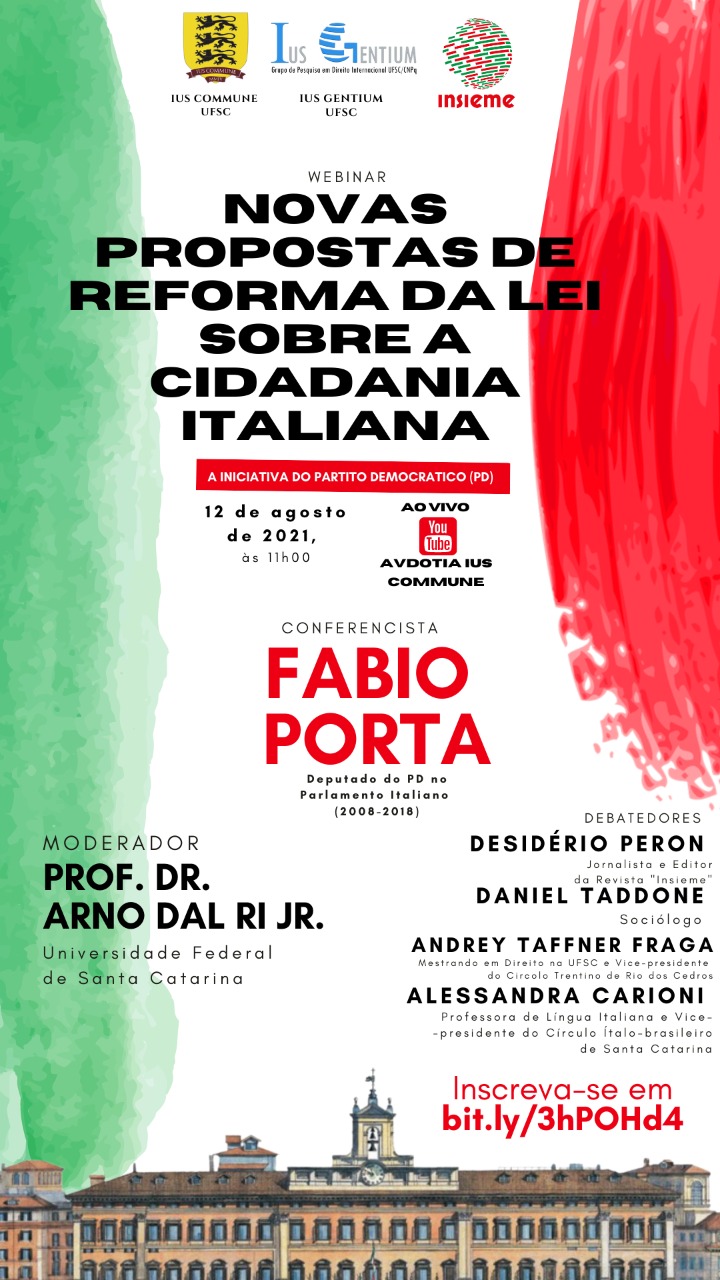
“Nuove proposte di riforma della Legge sulla Cittadinanza Italiana: L’iniziativa del Partito Democratico (PD)”
August 12, 2021 at 11:00 AM (Brasilia time)
Lecturer:
- FABIO PORTA, PD Member of the Italian Parliament (2008-2018)
Moderator:
- Prof. Arno Dal Ri Jr., Federal University of Santa Catarina
Debaters:
- Desidério Peron, Journalist and Editor of “Insieme” Magazine
- Daniel Taddone, Sociologist
- Andrey Taffner Fraga,
- Master’s degree in Law at UFSC, Vice-President of Circolo Trentino de Rio dos Cedros
- Alessandra Carioni, Italian Language Teacher, Vice-President of the Italian-Brazilian Circle of Santa Catarina
Organization:
- Ius Gentium – International Law Research Group – UFSC/CNPq
- Ius Commune – Research Group on The History of Legal Culture – UFSC/CNPq
Co-organization:
- Magazine “Insieme”
Registrations in this link.
-
Final Result: Scientific Initiation in The History of Law 2021/2022 – Prof. Diego Nunes
Access the link: resultado_pibic_diego_nunes_2021_assinado
-
Scientific Initiation in The History of Law – Prof. Diego Nunes – 2021/2022
PROFESSOR DIEGO NUNES, in the use of his duties, as provided in item 3.6.5 of Annex III of NORMATIVE RESOLUTION No. 17/CNPq, OF JULY 6, 2006, in Article 17 of NORMATIVE RESOLUTION No. 39/CUn, MAY 20, 2014 and in item 6.2.1 of Propesq Notice No. 01/2021 makes public the opening of registrations and establishes the rules for conducting a selection process aimed at classifying students who will develop scientific initiation activities in the period between September 2020 and August 2021, with 1 vacancy for scientific initiation scholarship approved preliminary by Propesq and 1 vacancy for voluntary scientific initiation, destined to wide competition.
Access the Notice
Inscriptions: https://forms.gle/AEQsaUr1GymAK3Th8
-
Fascisms in Europe and Brazil

We invite everyone to register and honor the lecture “Fascisms in Europe and Brazil”, which will be given by Professor Federico Losurdo of the Università degli studi di Urbino.
The activity is a joint effort of the research groups Ius Commune and Ius Gentium, the UFSC, the Center for the Studies of Historical and Geographical Materialism – Nino Gramsci and the Università degli studi di Urbino.
Registration can be made through the link bit.ly/3zILzGH.
-
The Napoleonic Code and the Legal Culture of Roman-Germanic Tradition

On 17/06, at 11am, The Ius Commune – Interdisciplinary Group on The History of Legal Culture UFSC/CNPq in partnership with other research groups in the history of legal culture, organizes a debate with Prof. Paolo Cappellini of the University of Florence (Italy), a conversation on the codification of law in the bicentenary of napoleon’s death, who carried out such legislative policy in France and the occupied territories. The broadcast will be live on our YouTube channel.
YouTube channel: https://www.youtube.com/c/AvdotiaIusCommuneUFSC
Partner Groups:
- Studium Iuris – Grupo de Pesquisa em História da Cultura Jurídica (UFMG);
- Iura Populorum – Grupo de Estudos e Pesquisa em História da Cultura Jurídica (UniFAP);
- Percursos, Narrativas e Fragmentos – Grupo de Pesquisa em História Constitucional Brasileira (UnB);
- CERCO – Controle estatal, racismo e colonialidade (UFRJ);
- Direito, Democracia e Participação Cidadã (Unochapecó);
- Ius Gentium – Grupo de Pesquisa em Direito Internacional (UFSC);
-
Book Launch: Economics and Politics vs. Freedom: questions of law on the Atlantic slave trade in the 19th century

On 13/05, at 11:00 a.m., we will meet several research groups to discuss the recent book of the dear friend and fellow law history professor at the University of Milan (Statale) on the Atlantic trafficking of Africans to be enslaved in the Americas. The research was used by multiple sources that take into account both the legal dimension and that of legal thought and judicial and diplomatic praxis.
-
Book: Studies in the History of Criminal Law and Criminal Justice
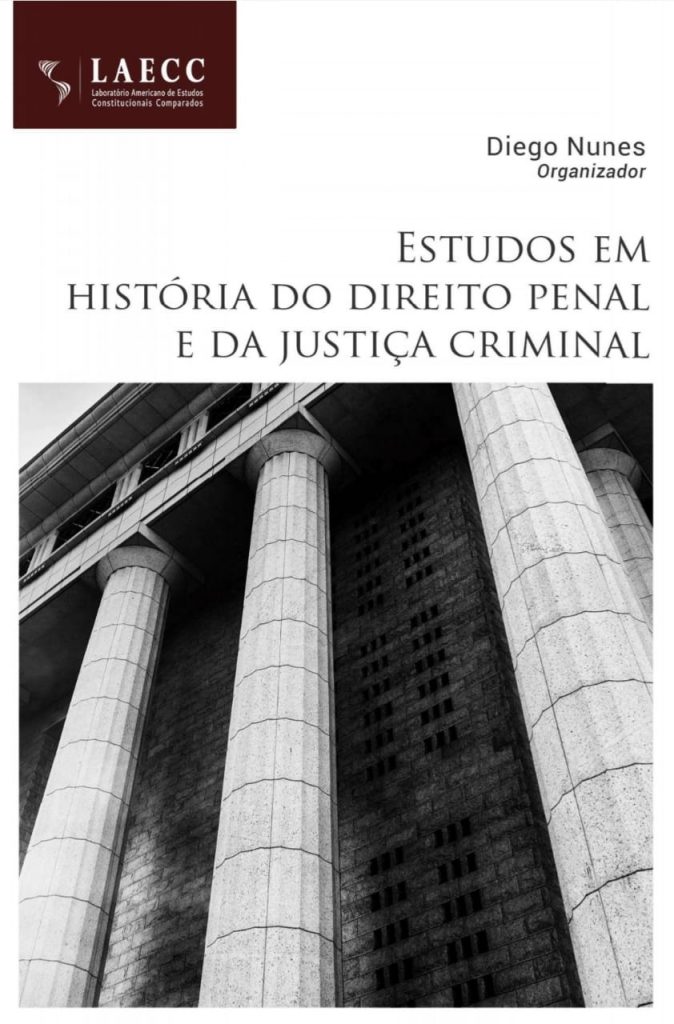
It is with joy to present the book Studies in history of criminal law and criminal justice, organized by Professor Diego Nunes from the collective effort led by Ius Commune – Research Group on The History of Legal Culture – UFSC/CNPq and with the help of Studium iuris – Research Group on The History of Legal Culture – UFMG/CNPq, as well as historians of brazilian and European law. This book aims to contribute to the affirmation of the field of the history of law in Brazil, and the history of criminal law and criminal justice in particular.
The work takes care of a temporal arc with approximately two centuries, encompassing the foundation of legal modernity at the end of the eighteenth century, and nineteenth century and some modern declinations throughout the twentieth century.
Click here to access the full book!
Contents
Presentation
Technical Note
Contents
Part I
History of Criminal Law and European Criminal Justice
- Chapter 1 | Judicial sources and legal sources: reflections on the current stage of studies on the history of crime and criminal justice – Mario Sbriccoli
- Chapter 2 | The legislator’s response: reforms and restorations in criminal justice after Beccaria – Ettore Dezza
- Chapter 3 | Cain’s mark: the search for the “delinquent man” between medicine and law – Paolo Marchetti
- Chapter 4 | The role of the “personality of the State” in the criminal elaboration of Italian fascism: laesa maiestas and technicality-legal in the Rocco Code (1930) – Arno Dal Ri JR., Kristal Moreira Gouveia
- Chapter 5 | Extraction in fascist Italy (1922-1943) and in Brazil by Getúlio Vargas (1930-1945): between the rise of the “criminal law of fascism” and the survival of the liberal tradition of criminal law – Diego Nunes
Part II
History of Criminal Law and Luso-Brazilian Criminal Justice
- Chapter 6 | “Without perfect and legal proof no one should be punished”: the regime of evidence in the project of Criminal Code of Mello Freire – Marina Tanabe do Livramento, Murilo Aparecido Carvalho de Robbio
- Chapter 7 | Reminiscences of death as a penalty in the portuguese criminal codification process: from the Philippine Ordinances to the Penal Code of 1886 – Giácomo Tenorio Farias
- Chapter 8 | The last hanged in the province of Rio de Janeiro (1869): notes to the “biography of Ramon Nietto by a fellow inmate” – Joao Luiz Ribeiro
- Chapter 9 | Absence of criminalization of women who abort in the Criminal Code of 1830: the protection of private spheres of punishment before the slave regime – Barbara Madruga da Cunha, Mario Davi Barbosa
- Chapter 10 | From apothecaries to traffickers: the mistaken belief in terminological and dogmatic identity as a character of continuity in brazilian criminal drug policy between the Criminal Code of 1890 and the special criminal laws of the 1910s and 1920s – Ricardo Ávila Abraham, Carlos César Rodrigues
- Chapter 11 | The legal culture of criminalization of Afro-Brazilian religions: the experience of São Pedro do Uberabinha (Minas Gerais) – Vanilda Honória dos Santos, Biatriz Bittencourt de Assis
- Chapter 12 | Reflections on the Positive School: the reinterpretation of its institutes in the Brazilian Penal Code of 1940 – Julia Farah Scholz
- Chapter 13 | The crime of abortion in the Penal Code of 1940 and its “substitute” of 1969: a feminist analysis of discourses for its maintenance – Barbara Klopass Locks by Godoi, Tayná Ferreira


Translate »